



 Customer Consultation
 Resource Room
 Sales Offices/Service
Robotics
A company that understands the changes in the world and challenges the future through technological innovation.
BE THE BEST, BE THE FIRST

Why HFA?
Hardware Wisdom & Embodied Intelligence
HIGEN HFA goes beyond motor manufacturing. We design joint-level compliance and intrinsic safety so humans and robots can physically interact in shared spaces with complete peace of mind.

3 Hardware Wisdom Pillars for Collaborative Robotics
Embodied Intelligence
Immediate response without waiting for central AI
Just as a human hand recoils from heat without waiting for brain decisions, HFA joints sense shock and immediately yield (<100ms).
Smart Force Control
Compliance via sensorless torque estimation
Without expensive external torque sensors, dual 24-bit encoders estimate friction and external forces to deliver smooth compliance.
Intrinsic Safety & Yielding
Flexible yielding mechanism alongside humans
In accidental collisions with humans, the joint instantly lowers stiffness to absorb impact energy, protecting both human and robot.
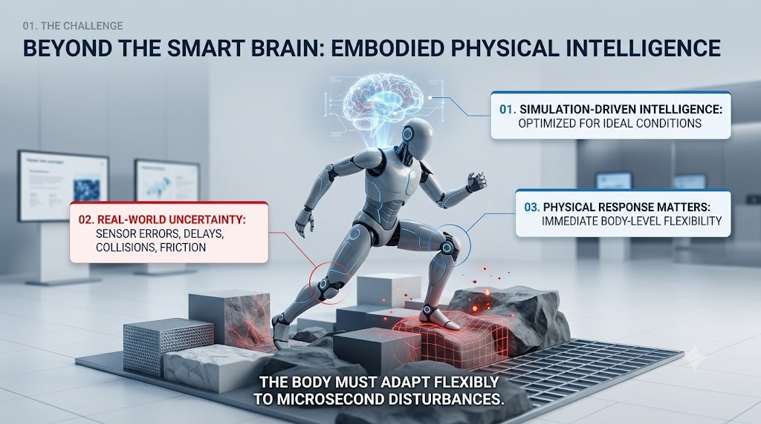
01. Robots Need More Than Just a Smart Brain
Even if central AI processes giant VLM models, physical disturbances occur in microseconds. The joint hardware itself must yield dynamically.
Intelligence trained in simulation is optimized for ideal conditions.
Reality is full of sensor noise, latency, friction, and environmental shocks.
Robot safety and natural motion begin from immediate body reflexes.
The Simulation Was Perfect.
Reality Was Not.
Motions that were perfect in virtual simulation collapse under real-world friction and payload fluctuations. HFA actively compensates for dynamic errors inside the joint.
Parameter Mismatch
Discrepancy between simulated models & physical reality
In simulation, mass, inertia, and torque remain unrealistically constant.
Physical parameter shifts due to component wear, assembly tolerance, and heat.
Sensor Noise & Delay
Sensor errors, latency & incomplete data
Simulated data enjoys zero latency and zero measurement noise.
Real-world communication latency and noise destabilize feedback loops.
Actuator Nonlinearity
Distortion from friction, heat & vibration
Motor output torque and gear transmission maintain ideal linearity.
Nonlinear physical realities such as friction, cogging torque, and backlash distort motion.
Environmental Complexity
Unpredictable variables like impacts & humans
Idealized environments with flat ground and predefined objects.
Unpredictable contacts, collisions, and terrain requiring <100ms response.
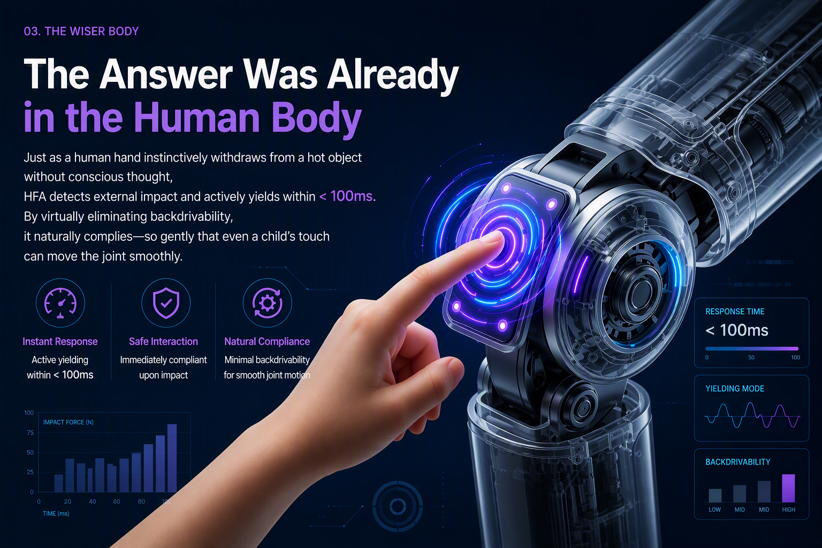
The Answer Was Already
in the Human Body
Just as a human hand recoils from heat without waiting for brain decisions, HFA joints sense shock and immediately yield (<100ms).
HIGEN Distributes Intelligence Across Three Layers
Dual encoders compare the positional displacement between the motor shaft and output shaft, while a current sensor measures changes in applied current. This data is fused through holding-torque compensation and a disturbance observer to estimate the direction and magnitude of external force without a dedicated torque sensor.
High-Level Control & Global Planning
Full-body motion and path planning, static gravity compensation
Efficient Communication Protocol
Bandwidth reduced to 20–50Hz, delivering trajectory goals
Actuator-Embedded Edge AI & Physical Control (<100ms)
Torque transparency, real-time shock detection, and impedance yielding at contact.
From Motion Component to Sensory Organ
A 3-layer architecture that slashes central communication overhead and handles physical disturbances locally at the joint level.
| Conventional Actuator | HIGEN Smart HFA (HFA Innovation) |
|---|---|
| Passive position/velocity command execution (Command-based drive) | Real-time active detection of force, contact & impact (Real-time force detection) |
| Simple repetition of fixed, predefined motion (Repetitive task) | Instantly adjusts torque and posture and yields |
| Focused on output power and precision alone | Focused on compliance and intrinsic safety |
| Waits for a central controller's decision | Instant on-site response within 100ms at the joint edge level (Level 3) |
Embodied Intelligence
More than a mere power component — realizes bodily intelligence that interacts with the physical world and adapts in real time.
Smart Force Control
Perceives external force through proprioceptive algorithms, without a torque sensor, to deliver optimal, smooth force control.
Safety (Yielding)
Delivers intrinsic physical safety that yields on its own to even the light force of a child's hand upon collision.
HIGEN Human Friendly Actuator
Powering the Next Generation of Humanoid Robots